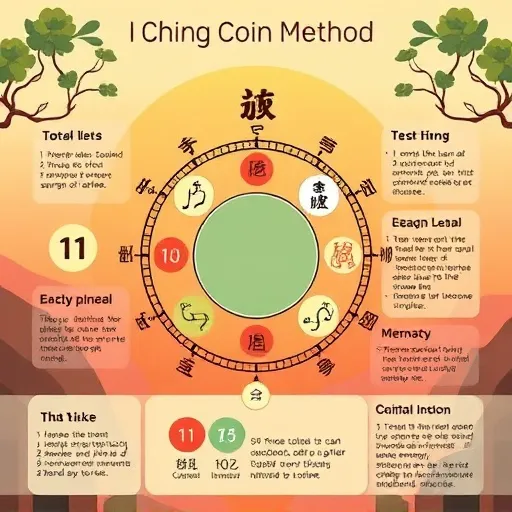
I Ching hexagrams an
What Is the I Ching Coin Method?
Before we get into the mechanics of the i ching coin method step by step, let's set the stage. The I Ching is built around 64 hexagrams — six-line figures that each represent a unique combination of yin (broken) and yang (solid) energy. Each hexagram carries layered meanings that practitioners interpret in the context of their question or situation. Think of it as a snapshot of the dynamic forces at play in your life at any given moment.
The coin method is a technique for generating these six lines one at a time. You toss three coins six times, and each toss produces one line of your hexagram. The coins determine whether each line is yin or yang, and also whether it's "changing" or "stable" — a detail that adds incredible depth to your reading. Understanding the i ching coin method step by step gives you a reliable way to access this ancient divination system without needing any rare tools or special training.
Why coins, though? Well, the coin method emerged as a simplified alternative to the traditional yarrow stalk ritual, which involves manipulating 50 dried stalks in a complex, time-consuming process. Coins are easy to find, easy to carry, and produce results that are just as meaningful when approached with proper intention. Many experienced practitioners believe the method matters less than the sincerity and focus you bring to the act of divination. The i ching coin method step by step approach has become the go-to for modern practitioners precisely because it's accessible and deeply rewarding.
Essential Tools and Preparations for Your First I Ching Coin Toss Ritual
One of the beautiful things about this practice is how little you need. Your minimal toolkit for the i ching coin method step by step includes just a few simple items:
- Three identical coins — Traditional practitioners often use Chinese bronze coins with a square hole in the center, but any three coins of the same denomination will work. Some people prefer coins that feel special or meaningful to them, as this enhances their personal connection to the ritual.
- A quiet space — You'll want somewhere you can focus without distractions. This doesn't have to be a formal altar; a clean table in a calm room is perfectly fine for your i ching coin method step by step session.
- A pen and paper — You'll be recording your lines as you go, so have something to write with and on. This is essential for tracking your hexagram construction accurately.
- A specific question — This is crucial. The I Ching responds best to clear, open-ended questions rather than yes/no queries. Your intention shapes the entire reading.
- A receptive mindset — Approach the i ching coin method step by step process with respect and curiosity, not skepticism or frivolity. Mindfulness and focus are your greatest allies here.
Some practitioners like to add extras like incense, a cloth to cast on, or a dedicated journal for their divination practice. But honestly, none of that is strictly necessary. What matters most is your intention and the quality of your attention as you begin the i ching coin method step by step process.
Decoding Yin Yang Values and Changing Lines in the Three Coin Toss System
Here's where things get specific. In the traditional three-coin method, each coin has two sides, and each side is assigned a value. This is the core mechanic of the i ching coin method step by step:
- Heads = 3
- Tails = 2
When you toss all three coins together and add up their values, you get one of four possible totals. Each total corresponds to a specific type of yin or yang line:
- 6 (three tails) — This is a "changing yin" line, drawn as a broken line with an X through it. It will transform into a yang line in your secondary hexagram.
- 7 (two tails, one heads) — This is a "stable yang" line, drawn as a solid line.
- 8 (two heads, one tails) — This is a "stable yin" line, drawn as a broken line.
- 9 (three heads) — This is a "changing yang" line, drawn as a solid line with a small circle beside it. It will transform into a yin line in your secondary hexagram.
If that sounds a bit technical, don't worry — it becomes second nature after a few tosses. The important thing to remember is that 6 and 9 are "changing" lines, while 7 and 8 are "stable" lines. Changing lines are significant because they indicate areas of movement or transformation in your situation. This value system is the backbone of the i ching coin method step by step, and once you internalize it, the entire process flows naturally.
I Ching Coin Method Step by Step: The Complete Casting and Interpretation Process
Now let's walk through the entire ritual from beginning to end. I'll break the i ching coin method step by step into clear, manageable stages so you can follow along easily whether you're a total beginner or returning after a long break.
Step 1: Prepare Your Space and Your Mind
Find a quiet spot where you won't be interrupted for at least 15 to 20 minutes. Clear your mind as best you can. Some people like to take a few deep breaths, light a candle, or simply sit quietly for a moment. The goal is to shift out of your everyday, distracted state and into a more focused, receptive frame of mind — a crucial first move in the i ching coin method step by step.
Hold your three coins in your hands for a moment. Feel their weight and texture. This simple act of grounding yourself before beginning is an important part of the ritual and helps set your intention for the divination ahead.
Step 2: Formulate Your Question with Clarity and Intention
This step is often overlooked, but it's genuinely one of the most important in the entire i ching coin method step by step process. The I Ching is not a fortune-telling machine that spits out yes or no answers — it's a tool for reflection and insight. Your question should be open-ended and focused on understanding a situation rather than demanding a prediction.
Good questions sound like:
- "What do I need to understand about my current career path?"
- "How can I best approach the conflict in my relationship?"
- "What energy should I bring to this new project?"
Questions to avoid include:
- "Will I get the job?" (Too binary — try rephrasing as "What should I know about my job prospects?")
- "Should I break up with my partner?" (This pushes the I Ching to make a decision for you rather than offering perspective.)
Once you've settled on your question, hold it clearly in your mind as you begin the i ching coin method step by step. Some practitioners like to write it down before starting the casting process, which helps anchor your focus.
Step 3: Toss the Coins for the First Line
Take all three coins in your cupped hands. Hold them near your chest or forehead, close your eyes if you like, and silently focus on your question. Then, with intention, let the coins fall onto a flat surface — a table, a book, a cloth spread on the floor. It doesn't matter where, as long as it's clear and stable.
Look at the result. How many heads? How many tails? Add up the values using the system above (heads = 3, tails = 2). Write down your result. Remember: the first toss gives you the bottom line of your hexagram, not the top. This is a crucial detail in the i ching coin method step by step that trips up many beginners. In the I Ching, lines are built from the bottom up — always.
Step 4: Repeat Five More Times for All Six Lines
Toss the coins again for the second line, then the third, fourth, fifth, and sixth. Each toss corresponds to the next line up in your hexagram. Take your time — there's no rush. In fact, many practitioners find that slowing down and really focusing on each toss helps produce a more meaningful reading. The i ching coin method step by step rewards patience and mindfulness.
By the end of six tosses, you'll have six lines recorded, each one either yang (solid) or yin (broken), and each one either stable or changing. This completes the casting phase of the i ching coin method step by step.
Step 5: Draw Your Hexagram with Precision
Now it's time to draw your hexagram. Starting from the bottom line (your first toss) and working upward, draw each line according to its value:
- Value 6: Broken line with an X in the middle (changing yin)
- Value 7: Solid line (stable yang)
- Value 8: Broken line (stable yin)
- Value 9: Solid line with a small circle at the end (changing yang)
Don't worry if your drawing isn't perfect. The important thing is that you can clearly identify which lines are changing and which are stable. This visual representation is a key checkpoint in the i ching coin method step by step.
Step 6: Identify Your Primary Hexagram and Trigrams
Once your hexagram is drawn, you'll need to identify which of the 64 hexagrams it corresponds to. You can do this by looking up the pattern in a reference table or using an I Ching app. The primary hexagram represents the current state of affairs — the overall energy and dynamics of your situation as it stands right now.
Most I Ching reference materials organize the hexagrams by their upper and lower trigrams. A trigram is a group of three lines (either solid or broken). Your hexagram consists of two trigrams stacked on top of each other — a lower trigram and an upper trigram. Identifying your trigrams is usually the fastest way to locate your hexagram in a reference book, and it deepens your understanding of the i ching coin method step by step.
Step 7: Create Your Secondary Hexagram for Deeper Insight
If any of your lines are changing (values 6 or 9), you'll create a secondary hexagram. To do this, simply change each changing line into its opposite: a changing yin becomes a yang, and a changing yang becomes a yin. Stable lines stay exactly the same.
The secondary hexagram represents the direction things are moving in — the potential outcome or the energy that's emerging as your situation evolves. Reading both hexagrams together gives you a much richer picture than reading only the primary one. This two-layer approach is what makes the i ching coin method step by step so powerful for reflection and insight.
Step 8: Read and Interpret Your Hexagram with Patience
Now comes the part that requires the most patience and practice: interpretation. Read the description of your primary hexagram in your reference material. Pay attention to the overall theme, the advice offered, and the tone of the commentary. If you have changing lines, read the specific texts associated with those lines. Different traditions handle changing lines differently — some focus on the moving lines as the heart of the reading, while others emphasize the secondary hexagram. You'll develop your own approach over time as you continue with the i ching coin method step by step.
Don't expect a clear-cut "answer." The I Ching speaks in symbols and metaphors. Sometimes the meaning will be obvious; other times it will require reflection. Take notes on your initial impressions and revisit them later — meaning often unfolds over days or even weeks.
Practical Tips and Common Mistakes for Meaningful I Ching Divination Readings
After you've done a few readings with the i ching coin method step by step, you'll start to develop your own rhythm and preferences. Here are some tips that can help you get the most out of the coin method:
- Keep a divination journal. Record your question, your hexagram, your interpretation, and what happened afterward. Over time, this creates a fascinating record of your inner and outer life.
- Don't cast repeatedly on the same question. The I Ching is not a slot machine. If you get an answer you don't like, sit with it rather than immediately re-casting. Experienced practitioners consider repeated casting on the same issue disrespectful to the ritual.
- Use a dedicated set of coins. Many people find that keeping a specific set of coins for divination only deepens their connection to the practice.
- Cast with fresh energy. If you're feeling angry, exhausted, or scattered, wait until you're calmer. Your state of mind affects the quality of your focus.
- Study the foundational concepts. Learning about yin and yang, the eight trigrams, and the nature of change will dramatically improve your ability to interpret hexagrams.
Looking back on my own early experiences with the i ching coin method step by step, there are several pitfalls I see beginners fall into again and again. Building the hexagram from the top down is the single most common error — remember, the first toss is the bottom line. Misunderstanding changing lines (values 6 and 9, not 7 and 8) is another easy mix-up. Asking yes/no questions misses the point entirely. Ignoring the secondary hexagram is like reading only the first page of a book. Treating the reading as absolute fate misunderstands the I Ching's purpose — it's a dialogue, not a decree. And skimping on intention rarely produces a satisfying reading. The i ching coin method step by step is simple, but the quality of your attention is what gives it depth.
Why the Ancient I Ching Coin Method Still Resonates in 2026
In an era dominated by rapid technological change, constant connectivity, and algorithmic decision-making, the I Ching's appeal has actually grown. Many people today are seeking slower, more deliberate ways of reflecting on their lives — practices that demand patience and reward contemplation. The i ching coin method step by step fits perfectly into this desire for a more grounded, analog approach to self-reflection and divination.
The coin method requires no screen, no subscription, and no digital connection. It's just three coins, six tosses, and a willingness to sit with uncertainty. That simplicity feels almost radical in a world that constantly pushes us toward speed and efficiency. Some digital practitioners use I Ching apps to cast hexagrams, and that's perfectly valid — but many people find that the physical act of tossing real coins creates a tangible sense of ritual that apps can't replicate. The weight of the coins in your hand, the sound they make as they land, the tactile act of recording each line on paper — these small sensory details anchor the i ching coin method step by step in something real and present.
Whether you're drawn to the i ching coin method step by step for its philosophical depth, its divination value, or simply the meditative quality of the ritual, it's worth exploring. It's one of those practices that rewards ongoing engagement — the more you work with it, the more layers of insight you uncover.